AI Is Compressing Operating Cycles. Most Leaders Aren’t Ready.

AI is not a feature.
It is not a co-pilot.
It is not a faster intern.
It is a compression engine.
For two decades, most operating models were built around friction.
Time delays. Hand-offs. Review cycles. Budget approvals. Research phases. Production bottlenecks. Human bandwidth constraints.
AI is systematically removing those assumptions.
This is not a productivity story.
It is an operating model story.
And most leaders are still treating it like a workflow upgrade.
What Is Being Compressed?
The impact is structural.
1. Time
Generative AI has already demonstrated measurable productivity gains across knowledge work. In controlled studies of customer support agents, AI assistance significantly increased issues resolved per hour while improving quality scores (see Generative AI at Work, NBER working paper)
Brookings similarly highlights that AI is reducing task completion times across sectors, accelerating how quickly value is delivered.
This is cycle compression.
Planning cycles that took weeks now take days.
Research that required multiple analysts can be synthesized in minutes.
Content that required multi-step handoffs can be generated, refined, and deployed within a single work block.
When time compresses, advantage shifts from scale to adaptability.

2. Teams
AI does not eliminate teams overnight.
But it changes the shape of contribution.
Recent academic research shows that AI-assisted individuals can perform at levels approaching traditional multi-person teams in certain structured tasks.
That matters.
Traditional growth stacks often assume specialization:
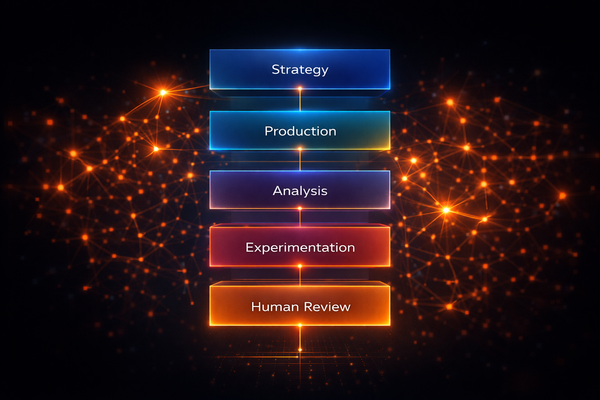
Research → Strategy → Creative → Analytics → Reporting.
AI collapses parts of that stack into a single leveraged operator.
The marginal value of an AI-native operator is rising faster than the marginal value of incremental headcount.
3. Capital
Historically, experimentation required upfront capital.
Agencies. Vendors. Dedicated production teams. Media spend before validation.
McKinsey estimates generative AI could contribute trillions in annual economic value by reshaping workflows across functions.
Lower cost of execution lowers cost of testing.
Lower cost of testing lowers barriers to entry.
If your competitive moat assumes capital intensity as protection, that assumption is weakening.
4. Feedback Loops
The most overlooked compression effect is learning speed.
AI accelerates iteration cycles — draft, simulate, refine, redeploy.
Bain notes that organizations embedding AI into decision loops see accelerated performance improvement through faster feedback integration.
Operating models built around quarterly recalibration are going to feel increasingly slow.

Why Most Leaders Aren’t Ready
Because most leaders are optimizing inside the existing architecture.
They are asking:
“How do we use AI in this workflow?”
Instead of:
“What does this workflow look like when friction disappears?”
That distinction matters.
If execution compresses, approval chains should compress.
If planning compresses, headcount strategy should change.
If experimentation cost drops, capital allocation should shift.
AI does not just accelerate tasks.
It challenges structural assumptions.
Layering AI on top of slow-cycle governance creates tension.
Eventually, that tension becomes a performance gap.
What I Would Test Now
If I were leading a growth organization today, I would run three compression experiments:
- Collapse one major planning cycle by 50 percent.
Force constraint. Remove nonessential approvals. See what breaks. - Replace one outsourced function with an AI-leveraged internal operator.
Not primarily to cut cost. To test leverage. - Reevaluate hiring plans through a compression lens.
Before adding headcount, ask whether AI-enabled capacity shifts the calculus.
The goal is not reckless acceleration.
It is structural awareness.
A Builder’s Note
While evaluating whether to rebuild the AI layer inside a product I’m currently working on, one insight became clear:
The constraint was not tooling.
It was legacy assumptions about timeline and sequencing.
Once those assumptions were challenged, development cycles compressed dramatically.
The risk was not under-building.
The risk was moving too slowly.
That lesson applies beyond product.
The Real Question
AI will not replace every function.
But it will replace operating models that assume friction as a permanent constraint.
The question is not whether AI increases productivity.
The question is:
Which organizations are willing to redesign themselves around compression?
Most leaders are experimenting.
Few are restructuring.
That gap will matter.
Signal over noise.