
Inside the AI-Native Marketing Stack
It’s easy to say AI is a force multiplier. It’s harder to build the system that makes that true.
Right now, most marketers are using AI tactically. Draft some copy. Summarize a report. Generate a few headline variations before a meeting. Useful, yes. Transformational, not quite.
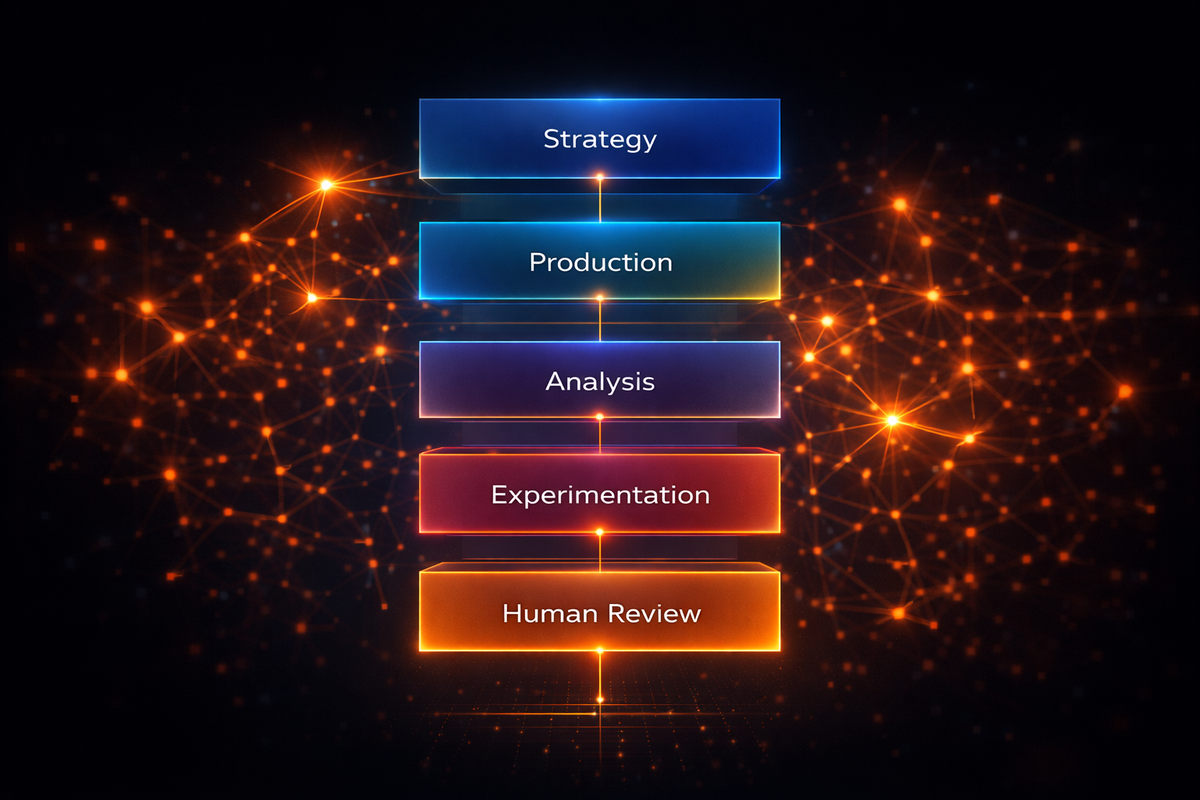
A stack is different. A stack is intentional. It has layers, flow, friction points, and review loops. It changes how work moves, not just how fast it moves.
Here’s how I’ve been structuring mine.
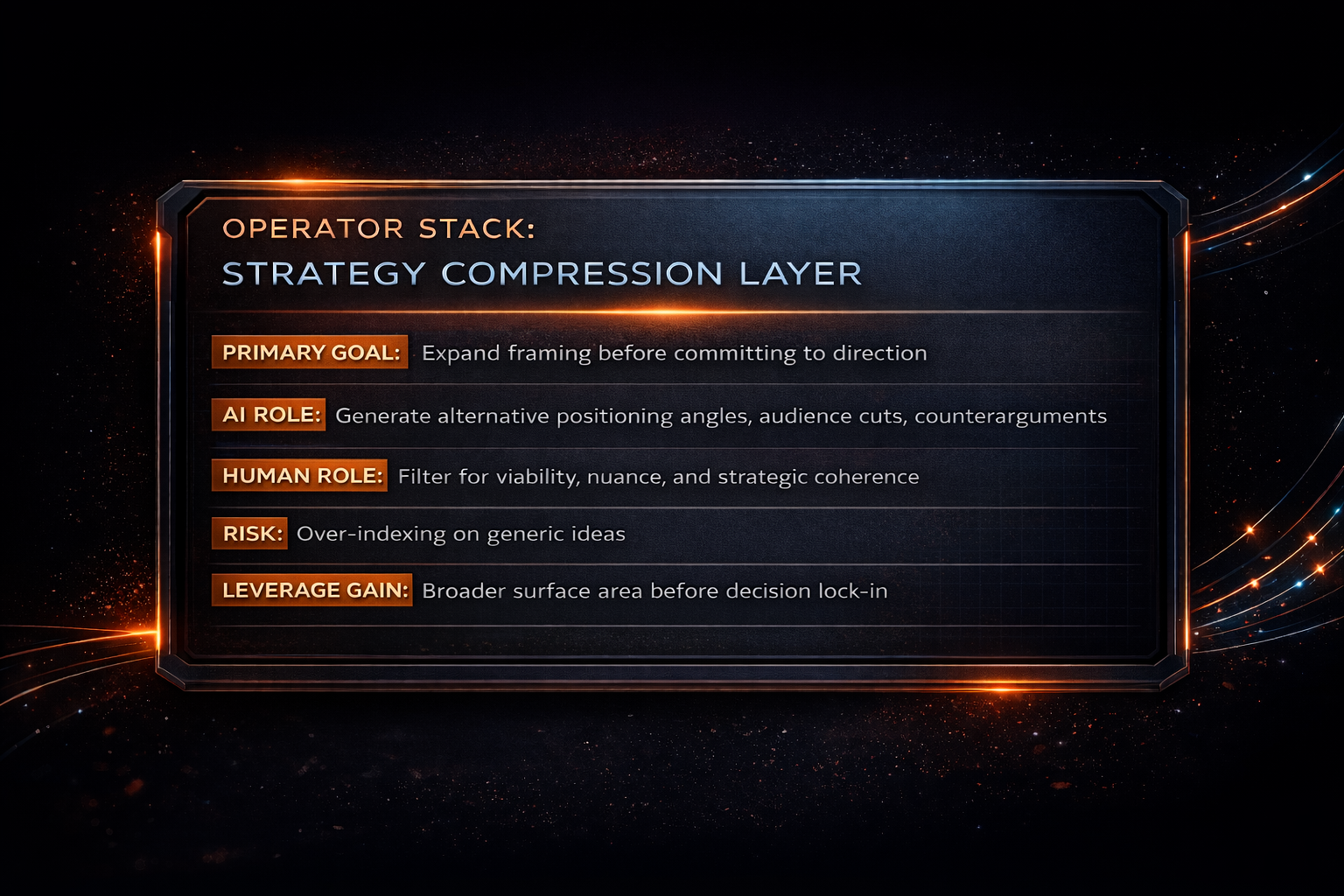
1. Strategy Compression
Before I write a brief, I now pressure-test it.
Instead of starting with a single framing, I’ll ask AI to surface alternate positioning angles, adjacent audience segments, counterarguments, or second-order effects. In minutes, I’m looking at a broader option set than I would have generated alone.
This aligns with what Ethan Mollick has described as AI acting as a layer of “co-intelligence” rather than a replacement for expertise.
The difference is not that the machine is smarter. It’s that it expands the thinking surface area. I still decide which angles are viable, which are generic, and which introduce real edge. But the starting point is richer.
The practical impact is time. What used to take a half day of whiteboarding compresses into a tighter cycle. That gives me more room for refinement instead of staring at a blank screen.
2. Structured Production, Not Random Generation
Execution used to bottleneck here. Now, AI handles structural scaffolding.
Campaign outlines. Messaging hierarchies. Variant matrices. First-pass landing page flows.
I don’t use AI to “write the ad.” I use it to build the architecture quickly so I can spend time sharpening the voice and tightening positioning.
This is where many teams misunderstand automation, imo. As Harvard Business Review has noted, the advantage often comes not from replacing humans, but from redesigning workflows around augmentation.
If the workflow doesn’t change, AI becomes a novelty. If the workflow does change, output expands without chaos. That distinction matters!
3. Data Synthesis Before Interpretation
Most marketing teams are not short on dashboards. They’re short on synthesis.
AI is exceptionally good at scanning structured data and surfacing patterns, anomalies, or outliers. I use it to draft first-pass insights from performance reports, compare segment behavior, or summarize trend shifts across campaigns.
What used to require manual tab-switching now becomes a conversation layer.
McKinsey estimates that generative AI could unlock trillions in productivity across industries, with marketing and sales among the most immediately affected functions, largely because of its impact on content creation and analytics workflows.
That productivity gain shows up most clearly in analysis compression.
But this is where experience becomes non-negotiable. AI can surface patterns. It cannot distinguish between statistical noise and strategic relevance without context. That layer still belongs to the operator (us!).
4. Experimentation Velocity
The quiet unlock then, is iteration speed.
If strategy compresses, production scaffolds faster, and analysis accelerates, you don’t just work faster. You run more cycles...
More concepts enter market. More variations get tested. More feedback loops close in a quarter.
Velocity compounds.
In growth terms, iteration speed becomes advantage. The team that learns faster adjusts faster. The team that adjusts faster reallocates capital smarter.
That’s not about replacing jobs. It’s about increasing surface area without increasing headcount.
The Non-Negotiable Layer: Human Review
An AI-native stack still has guardrails that need to come from real human operators... Judgment. Brand integrity. Ethical boundaries. Political awareness inside an organization.
If that layer disappears, you don’t get leverage. You get drift.
In practice, this means I build checkpoints into workflows.
AI drafts >> human refines
AI synthesizes >> human validates
AI proposes >> human decides
The goal is not automation for its own sake. It’s freeing attention for the decisions that actually move revenue.
Where This Is Going
This stack is evolving. I’m constantly refining prompts, tightening review layers, and connecting tools more cleanly. But the direction is clear.
AI doesn’t make marketers obsolete. It expands the range of what a single marketer can oversee.
The question isn’t whether you use AI. It’s whether you design around it. That’s where leverage lives.