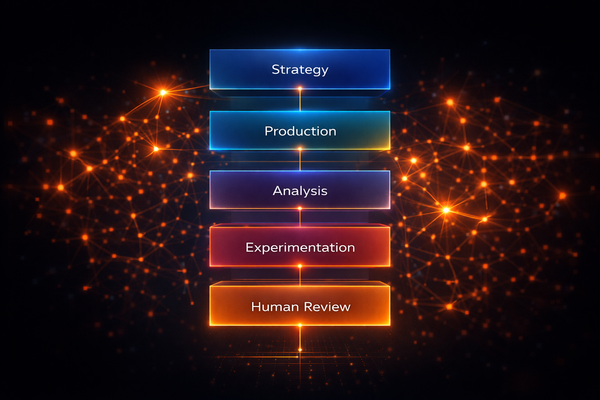
Better. Stronger. Smarter: Marketing Needs a Rebuild

If you grew up in the ’70s or ’80s, you probably remember the opening of The Six Million Dollar Man. A test pilot survives a catastrophic crash and is rebuilt with advanced technology. The narrator’s voice framed the entire premise with a bold promise: “We can rebuild him. Better. Stronger. Faster.”
It wasn’t a story about replacement. It was a story about reconstruction – about enhancing capability without discarding judgment, experience, or mission clarity.
That distinction feels increasingly relevant.
Much of today’s AI conversation in marketing revolves around acceleration. Faster content generation. Faster campaign setup. Faster reporting. Faster iteration. The implicit assumption is that speed equals advantage.
It doesn’t!
Marketing doesn’t need acceleration layered on top of yesterday’s operating model. It needs structural redesign.
The Problem With “Add AI and Go”
Right now, many organizations are taking existing workflows – linear campaign cycles, siloed channel teams, lagging measurement systems – and bolting AI tools onto them. The expectation is that automation will create leverage.
But leverage doesn’t come from speed alone. It comes from system design.
When AI compresses the distance between insight and execution, the physics of marketing change. Decision loops shorten. Creative cycles tighten. Data moves closer to the moment of action. If the organization isn’t structured for that compression, acceleration simply amplifies inefficiency.
In AI Is Compressing Operating Cycles, I wrote about how velocity itself is becoming a strategic variable. When time collapses, hierarchy, approval layers, and legacy measurement models become friction.
AI doesn’t fix friction. It exposes it.
The Upgrade Marketing Actually Requires
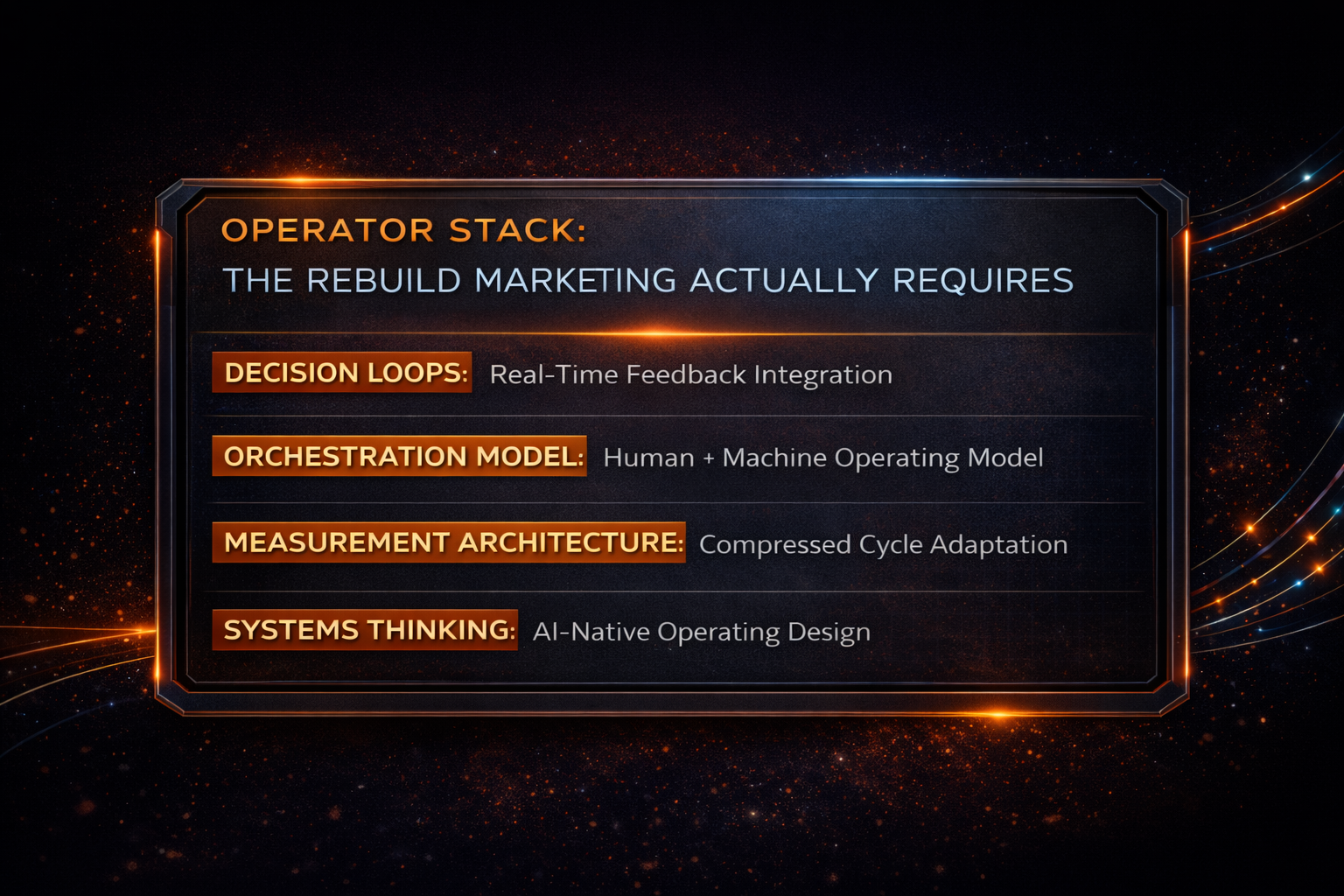
Rebuilding marketing for the AI era means redesigning the operating system, not just the interface.
It means rethinking how decisions are made and how quickly they can be made. It means rebuilding measurement architecture to match compressed cycles. It means moving from channel management to system orchestration. And it means shifting human roles from production to direction.
In The Rise of the Marketing Conductor, I explored how leadership itself is evolving. As machines generate output, the human advantage shifts toward orchestration: knowing what to direct, when to intervene, and how to align creative, data, and distribution into a coherent system.
Similarly, in Inside the AI-Native Marketing Stack, I argued that stacking tools is not the same as designing a system. The winners in this era will not be those who adopted the most AI products. They will be those who architected their stack around leverage.
Technology is the enhancement. Strategy remains the driver.
AI can accelerate execution, but without architectural redesign, acceleration becomes chaos.
A Personal Inflection Point
This thesis isn’t theoretical for me.
After years operating across brand, performance, and platform environments – from global brands to high-growth digital ecosystems – I recently stepped into a new chapter. Transitions have a way of sharpening perspective. They force you to ask whether you’re simply optimizing within an existing system or helping redesign it.
At the same time, I’ve been building and experimenting with AI-driven systems outside the confines of a traditional org chart. Watching machines compress time in real workflows makes one thing obvious: the real opportunity isn’t incremental efficiency. It’s structural leverage.
The rebuild is not optional. It’s underway.
The Bionic Fallacy
The Six Million Dollar Man didn’t succeed because he had hardware. He succeeded because enhanced capability was paired with discipline, judgment, and mission clarity.
That’s the lesson for marketing.
AI does not replace operators. It amplifies them – if the system is rebuilt correctly. If it isn’t, AI simply makes existing weaknesses visible at greater speed.
We don’t need a faster intern.
We need a better operating model.