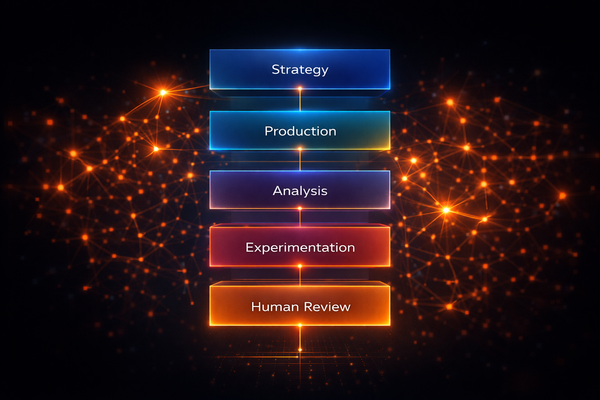
The AI Flavor Guide for Marketers

If you’ve tried to keep up with AI tools lately, you’ve probably had the same experience.
You open a list of “Top 50 AI Tools” and start scrolling. ChatGPT. Claude. Gemini. Jasper. Midjourney. Runway. Pika. Motion. Surfer. Agents. Something new launched yesterday.
At first it feels exciting. Then it becomes overwhelming.
Not because the tools aren’t interesting, but because there are so many of them. Each one promises to transform how marketing works. Each one claims to save time, unlock creativity, or automate something that used to require a team.
For marketers trying to make sense of it all, the experience starts to feel a bit like walking into an ice cream shop with fifty flavors.
Chocolate. Pistachio. Cookie dough. Salted caramel. Something called “galactic swirl.”
They’re all ice cream. But they’re clearly not meant for the same moment.
You wouldn’t order mint chip when you’re craving chocolate. And you probably wouldn’t grab a triple scoop when what you really wanted was a quick taste.
AI works the same way.
Different tools serve different jobs in the marketing workflow. The challenge isn’t trying every new flavor that shows up on the menu. It’s understanding what each one is actually good for and when it makes sense to use it.
Think of this piece as a flavor guide to the modern AI stack.
The Operator Problem
Most discussions about AI tools focus on features. Operators tend to think about the problem differently.
Instead of asking what a tool can do, they ask questions like:
- Where does this fit in the workflow?
- What job does this tool actually do?
- Does it replace a step, or simply accelerate one?
When you start viewing AI through that lens, the landscape becomes easier to understand.
Instead of a long list of tools, you begin to see categories of capability.
Here’s a simple way to think about the current AI landscape for marketers:
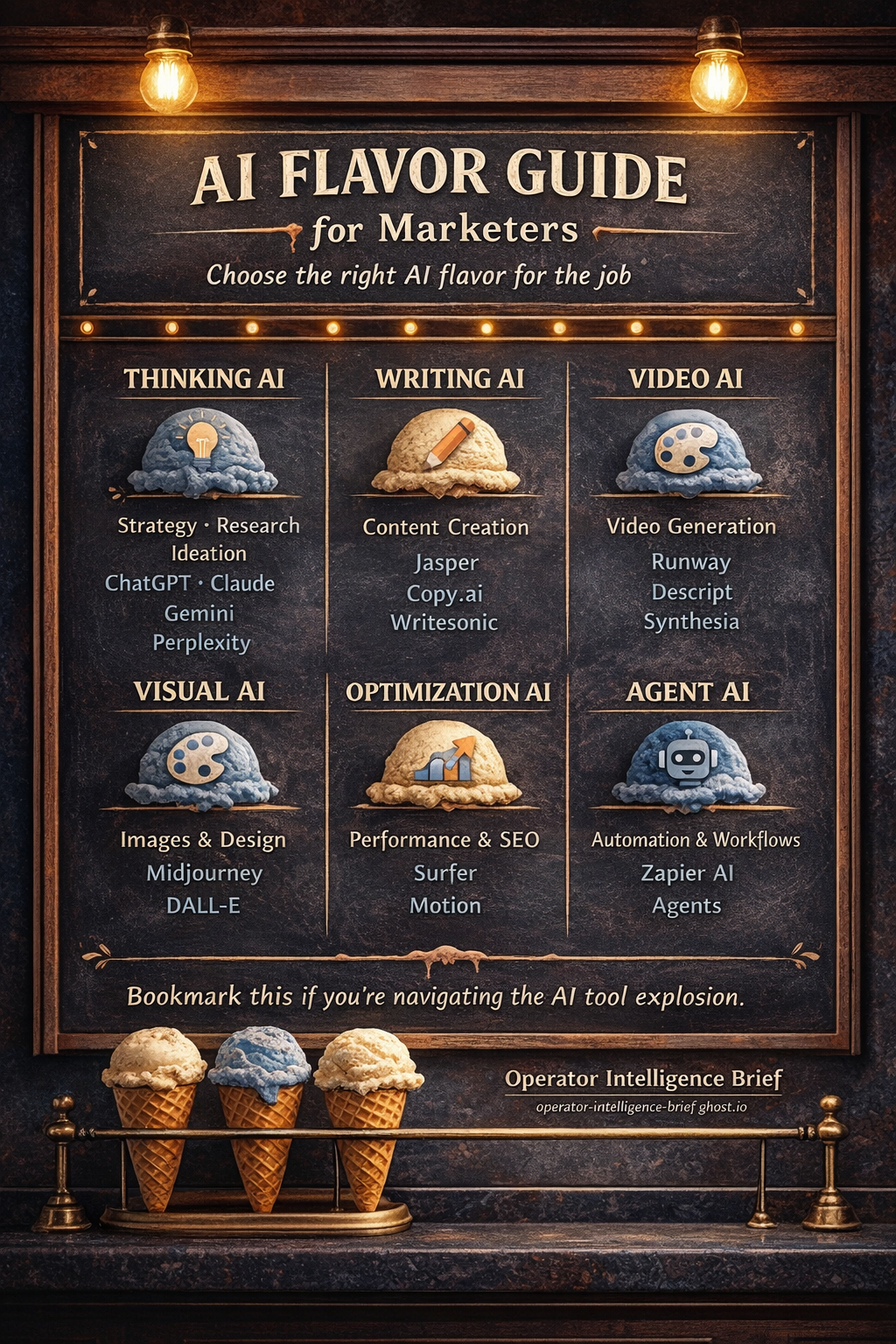
Now let’s take a closer look at what each of these flavors is actually good for.
Thinking AI
Flavor: The Classic Base
Examples: ChatGPT, Claude, Gemini, Perplexity
Every scoop starts with a base.
In the AI world, that base is the large language model.
These tools help marketers think.
Use them for:
- strategy development
- research synthesis
- market analysis
- messaging frameworks
- brainstorming
Many marketers still treat tools like ChatGPT primarily as writing assistants. But their real power often shows up earlier in the workflow, during the thinking phase.
They help accelerate the process of turning raw information into structured ideas.
Think of Thinking AI as the vanilla or chocolate of the AI world. It’s foundational and incredibly versatile.
Writing AI
Flavor: The Workhorse Scoop
Examples: Jasper, Copy.ai, Writesonic, Notion AI
If Thinking AI is the base, Writing AI is the scoop that gets served most often.
These tools specialize in generating marketing copy at scale.
Use them for:
- blog drafts
- email campaigns
- ad copy variations
- landing page first drafts
For marketers managing multiple channels and constant content demands, this can dramatically increase output.
But it’s important to remember what these tools actually are.
They’re draft accelerators.
Your brand voice, perspective, and judgment still come from you.
Visual AI
Flavor: The Creative Swirl
Examples: Midjourney, DALL·E, Adobe Firefly, Canva AI
Visual AI tools generate imagery and design concepts from prompts.
For marketers, this dramatically speeds up the creative process.
Use them for:
- campaign concept exploration
- social graphics
- creative mood boards
- visual storytelling
Instead of waiting for the first round of creative concepts, marketers can now explore dozens of directions quickly.
Think of this as the swirl flavor that adds personality to the experience.
You may not use it every day, but when you do, it can change the entire feel of a campaign.
Video AI
Flavor: The Deluxe Sundae
Examples: Runway, Synthesia, Descript, Pika
Video used to be one of the most resource-intensive forms of marketing content.
AI tools are rapidly lowering the barrier.
Use them for:
- explainer videos
- product demos
- repurposing webinars
- social media clips
A single long-form piece of content can now become multiple shorter formats within minutes.
Think of this category as the deluxe sundae. A little more elaborate, but incredibly powerful when used well.
Optimization AI
Flavor: The Secret Ingredient
Examples: Surfer SEO, Motion, Semrush AI
While other AI tools focus on creation, Optimization AI focuses on performance.
These tools analyze what’s working and recommend improvements.
Use them for:
- SEO optimization
- creative testing
- campaign performance insights
- keyword strategy
This category is often overlooked, but it’s one of the most valuable.
Optimization AI helps shift marketing from intuition-driven decisions to data-informed improvements.
Agent AI
Flavor: The Future Special
Examples: Zapier AI, AI agents, workflow automation
The newest category of AI tools goes beyond assisting marketers.
These tools execute workflows automatically.
They can:
- trigger marketing campaigns
- update CRM systems
- generate reports
- coordinate tasks across platforms
In other words, AI begins to behave less like a tool and more like an operating layer for marketing systems.
This is where things get especially interesting.
The Operator’s Takeaway
The future of AI in marketing isn’t about mastering one tool.
It’s about understanding the menu.
Each of these AI categories plays a different role in the marketing workflow. Thinking tools help shape ideas. Writing tools accelerate production. Visual and video tools expand creative possibilities. Optimization tools improve performance. Agents begin to automate entire systems.
Used together, they begin to resemble something closer to a marketing operating system.
And like any good menu, you don’t need everything on it.
The best marketers won’t be the ones chasing every new flavor that appears. They’ll be the ones who understand what each option is good for and when it fits the moment.
Because sometimes you want the classic scoop.
Sometimes you want the sundae.
And sometimes you just want a quick taste of something new.
AI doesn’t replace marketing judgment. It simply gives us more flavors to choose from.