The Rise of the Marketing Conductor

There’s a lot of noise about AI and marketing jobs right now. Some of it sounds like panic. Some of it sounds like breathless hype. Most of it reduces the conversation to a binary question: will AI replace marketers?
That framing is lazy!
AI isn’t eliminating marketing. It’s changing what marketers oversee. And the shift is bigger than faster copy or auto-generated dashboards. The role itself is expanding.
If you look closely, I think there are three forces reshaping the job: volume, quality, and orchestration.
1. Volume: The Output Multiplier
For most of the last decade, output scaled with headcount. More campaigns meant more people. More personalization meant more production cycles. More testing meant more manual work.
AI breaks that relationship.
A single marketer can now generate ten campaign directions in the time it used to take to develop two. You can spin up dozens of creative variations without building each from scratch. You can synthesize performance data before the meeting even starts.
That’s not marginal efficiency. That’s expanded surface area.
More ideas go into market.
More experiments run in parallel.
More signal comes back.
And when iteration speed increases, learning velocity compounds. The constraint shifts from “Can we produce this?” to “Which of these deserves amplification?”
That’s already a different job.
2. Quality: Experience × Collective Intelligence
The volume conversation gets attention. The quality shift is more interesting.
AI isn’t just a speed tool. It’s a synthesis engine trained on a massive cross-section of patterns, structures, and examples. On its own, it can be generic. On its own, experience can become narrow.
Combine the two and something changes.
An experienced marketer brings context, trade-off awareness, political instinct (and scar tissue!) from past decisions. AI brings breadth of recall, structural suggestions, and rapid pattern comparison across domains.
The result is sharper first drafts, more robust scenario planning, and fewer blind spots. You see angles you might have missed. You stress-test assumptions faster. You refine framing before it ever leaves your screen.
That’s not the machine being “smarter.” It’s the machine expanding the field you’re thinking within.
Experience provides judgment. AI expands the menu of options.
Together, they elevate decision quality.
3. Orchestration: The Real Role Shift
This is where the metaphor earns its place.
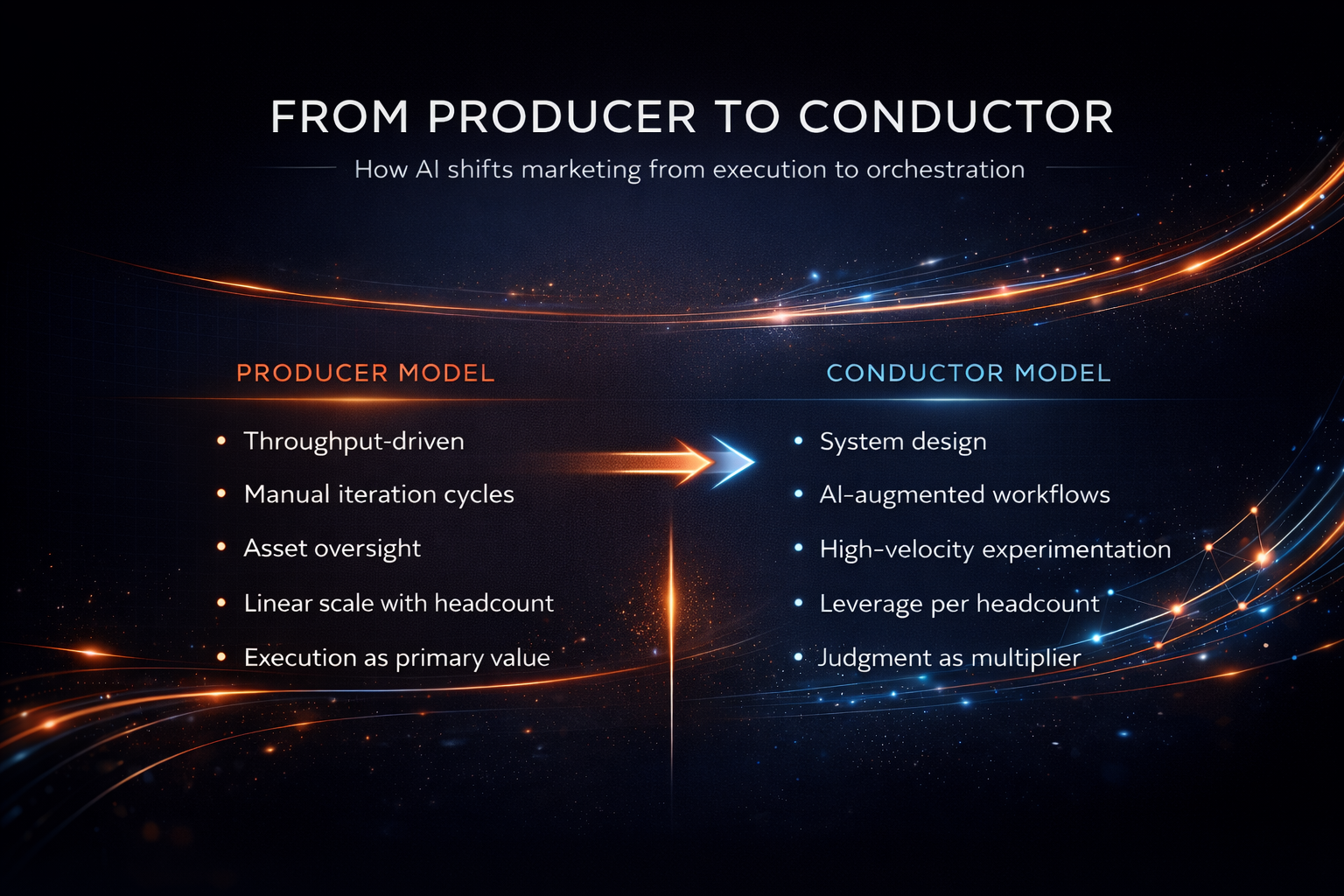
Marketing used to reward producers... people who could create, execute, and manage outputs at scale. That capability still matters, but it’s no longer the highest leverage point.
The leverage is moving to orchestration.
A conductor doesn’t play every instrument. They align them. They decide tempo. They decide emphasis. They interpret the room and adjust in real time.
In an AI-native marketing environment, you’re no longer just managing people and deliverables. You’re orchestrating:
- Human talent
- AI copilots
- Automation layers
- Data flows
- Experiment feedback loops
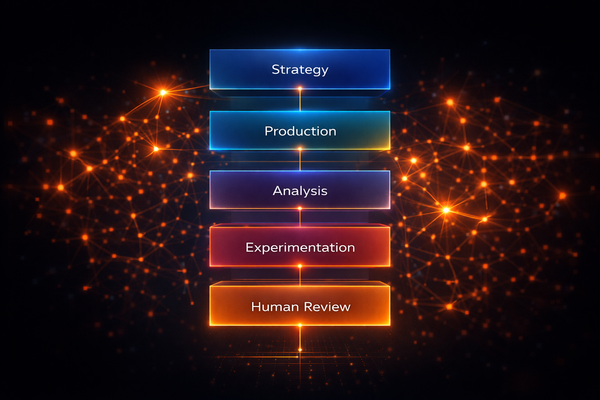
You’re designing the system that produces, tests, and refines the work.
That’s a broader mandate than asset oversight. It’s 'system design'.
The job moves up a level, from doing the work to architecting how the work gets done.
Building the Stack
This isn’t theoretical for me.
Over the past year, I’ve been building my own operating stack. AI-assisted strategy drafting tied to real briefs. Prompt libraries mapped to campaign stages instead of novelty use cases. Automated data synthesis layered with human review. Testing frameworks that compress iteration cycles without sacrificing rigor.
The goal isn’t to outsource thinking. It’s to remove friction around it.
If AI handles first drafts, structural assembly, and baseline analysis, I get to spend more time on framing the right problem, identifying second-order effects, and influencing the decisions that actually move revenue.
That’s the difference between producing more work and producing more impact.
The Opportunity
Competing with AI on execution is a race you don’t want to run. Designing workflows that integrate AI into how you think and operate is a different strategy entirely.
When you do that, three things happen:
You expand output without expanding headcount.
You improve decision quality by widening your field of view.
You increase the scope of what you oversee.
The marketers who thrive in this environment won’t be the ones producing the most assets. They’ll be the ones conducting the most leverage.
The role is expanding. The score is changing. And the music is just beginning.